Make your data talk: the key to enhancing your organization's web ecosystem
Understanding how your organization’s workflow or online presence could be improved with custom automation or integration.

Gregor Terrill

In 2026, the collection of systems that compose an organization’s internet presence is wild.
Your CMS-powered website uses an e-commerce plugin to process purchases through your payment gateway, sends customer receipts via your transactional email service, records conversions to your analytics platform, and updates the customer’s record in your CRM.
Somewhere out there, whether you’ve met them or not, some lucky web developer had to hook all those systems together. When a link in this chain fails, you notice. And like any good design: when it works perfectly, you don’t even think about it. So let’s take this opportunity to talk all about the wonderful world of integrations and what they can do for your organization. APIs and webhooks and two-way syncing, oh my!
Considerations for integration
Before we really get into it, let’s answer this question: why deal with the headache of trying to get multiple platforms to talk to each other, anyway?
Well, the alternative is to have a single system that does it all. This kind of system (often referred to as a “monolith”) has a lot of drawbacks. They’re incredibly expensive and time-consuming to build, since they need to reinvent every wheel and perform a lot of different functions. Inevitably, one or more of those functions is going to be a little underbaked, mostly there to serve as a bullet point on a feature list in the marketing material (“Yes, of course we can do email campaigns!”).
In addition, customers of such platforms are basically fully locked-in, and don’t always have a lot of bargaining power when it comes to feature requests or pricing changes down the road. After all, if all of your organization’s data is in a single system that someone else owns, migrating away from that system is going to require years of effort.
So having a collection of tools that each perform a few tasks very well tends to be the more common approach. If one of those tools falls behind the industry standard or no longer meets your organization’s changing needs, you can swap it out for another with a fraction of the disruption. The trade-off is, of course, that there’s often a bit of work involved in getting these tools to talk to one another.
Sometimes these systems will have plugins or APIs available as part of their offerings to make this process easier. Or sometimes additional tools designed for this specific purpose like Zapier or Make can sit in between to enable two (or more) of these systems to communicate. However it’s achieved, at its core, any integration between two systems is really just data being passed from one to the other. But there can be a lot to consider:
- When should data be requested or sent? At regular intervals, like at midnight every night? When a specific event occurs, like a customer making a purchase or saving changes to their profile?
- What format should the data be in? If one system has separate fields for First Name, Middle Name, and Last Name, but the other just has one Full Name field, how do we translate that data between the two systems? Which system is responsible for doing that translation?
- How do we verify the authenticity of the data and its sender? Is the data actually coming from the system we expect to be sending it? How do we protect both platforms from bad actors?
- If there’s a discrepancy, which platform’s data should be considered correct? In the software world, this is usually called the “source of truth”.
These are the sorts of problems that the lucky developer I mentioned gets to solve. The problems are not always simple, which is why you might need a trusted partner—like Alphabet®—to help.
So what can integrations actually do?
The simplest form of integration usually involves pulling data from external sources to enhance your own sites or applications. For Tourism Kingston, we’ve added currency conversion and weather widgets to help website visitors get information that’s relevant to their travel planning without needing to go looking for it off-site and potentially losing their attention. On Electricity Canada’s homepage, we automatically pull in the latest episode from their podcast platform. These are simple examples, but they enhance our clients’ websites without imposing any additional content management burden on their team, since we rely on external data sources that update automatically.
Improving the end-user experience on your website can also be accomplished by deeply integrating your own content with external tools and visualizations. When the Culinary Tourism Alliance approached us to build the online presence for their Great Taste of Canada program, we knew we wanted to incorporate visually striking interactive maps to help establish that sense of place. A static Google map just wasn’t going to cut it here. We used Mapbox to embed fully three-dimensional maps that seamlessly integrated with destination content entered in the CMS.
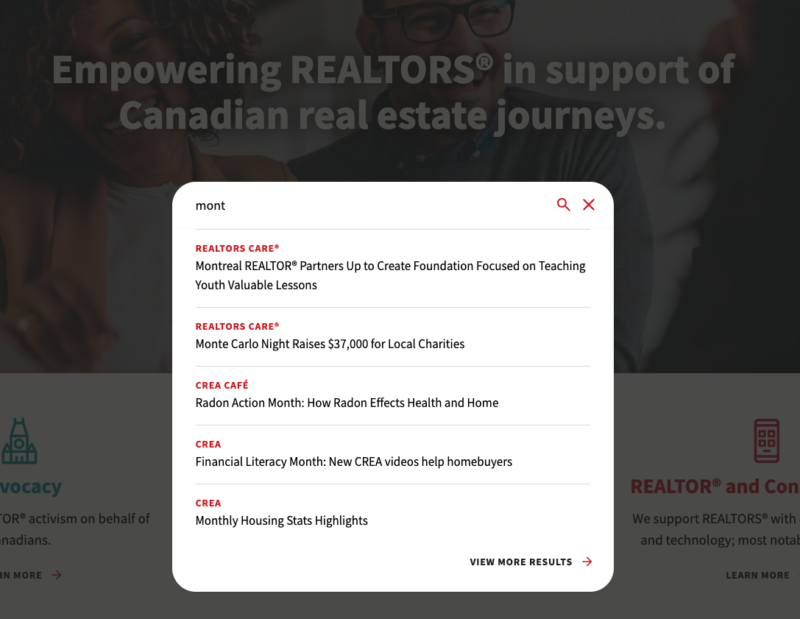
Another way to subtly enhance users’ experience is to eliminate the need for them to hunt for your content. When we rebuilt the website for the Canadian Real Estate Association a few years ago, they wanted their new site to be a central hub for REALTORS®. However, their wide breadth of content was distributed across their organizational website and multiple blogs. We built a custom search bar to combine the latest results from multiple websites under the CREA umbrella powered by Algolia’s industry leading search platform, helping visitors quickly find whatever they might be looking for.
Of course, content discoverability is only one of many problems facing large associations. Their members often need accounts, and with multiple platforms in play, this can often mean multiple accounts for each member. In these situations, single sign-on (SSO) becomes an invaluable tool, allowing your members to log into multiple platforms with a single account. This can save your team hours of dealing with lost credentials and confused users, and allow you to more easily track member journeys through your digital ecosystem. We’ve implemented SSO for several clients across multiple platforms and protocols.
Many of our association clients’ websites also feature member directories, which are integrated with internal member databases or full-on Association Management Software (AMS) systems. These generally sync on a scheduled basis, so the member services team only needs to update it in one system (the “source of truth”, if you remember), and it will automatically update on the public-facing website directory. In addition, the process of managing members often requires customized onboarding forms, subscription-based payments, email reminders, touchpoint logging, and more. We’ve done it all.
Where AI fits in
One thing I haven’t mentioned yet—and probably the integration you’ve seen pop up the most on the services and platforms you use—is AI. A handful of companies like OpenAI and Google operate the large language models (LLMs) that power the vast majority of the customer service chatbots and image generators that have popped up on what feels like every online platform.
At Alphabet®, we know AI can be a useful tool when implemented thoughtfully, but it isn’t the be-all and end-all solution to every problem. Over the past year, we’ve started rolling out AI integrations in several projects, including the Tourism Industry Association of Alberta’s custom-built Kate tool—Canada’s first AI-powered HR solution for tourism employers. If an AI-based integration makes sense for your organization, we can make it happen.
Building custom integrations isn’t something we reserve for client projects either! Our very own Zembaly™ advocacy platform relies on several integrations with other platforms:
- Current, location-based political representative data is compiled from a number of public data sources including open data APIs and various government websites.
- One-time payments and recurring subscription payments are handled by Stripe
- Emails to representatives and customers are handled by Mailchimp Transactional Email, which also provides some of the data for customer-facing reporting on campaign performance.
- Our new campaign-building AI assistant is powered by OpenAI
- Our staff is notified via our internal Slack channels when new users sign up or publish campaigns, so we can monitor usage and offer support to our customers.
How could integrations work for you?
With all of this in mind, take a minute to consider how your organization’s workflow or online presence could be improved with a custom automation or integration. Is there anywhere you find yourself duplicating data entry efforts? Could your team or your customers benefit from a dashboard that collects data from multiple sources into something more digestible? How could you improve your organization’s response time by getting notifications sent straight to your internal communication channels? Would your customers or members be more engaged if your website had interactive elements or self-serve tools
Whenever we embark on a new digital project with you, we’re always thinking about how and where automations and integrations could be used to streamline and improve processes. At Alphabet®, we’re here to build solutions for the hard problems (and the simple ones, too). Let us know how we can help connect and improve your organization’s digital ecosystem.